AI Research Scientist

Immagine creata con IAAI-generated image

AI Research Scientist: before the applications comes the research, and Europe must decide whether to keep it

Every Artificial Intelligence application we use today was born, years ago, in a scientific paper. The AI Research Scientist is the profile that generates that knowledge: it formulates theories, conducts reproducible experiments, publishes and submits to peer review. The US repertoires record it precisely; for Europe, which has set itself the target of twenty million digital specialists, the real question is another: will it be able to keep it?

There is a long timescale, in Artificial Intelligence, that the market cycles do not tell: the architectures that today underpin generative systems were born in the laboratory long before they became products. That time belongs to the AI Research Scientist, the figure devoted to exploring the frontiers of the discipline to generate new knowledge and theoretical paradigms, ensuring methodological rigour, reproducibility and responsibility.

The craft, in the official US repertoires

The Occupational Information Network (O*NET) of the US Department of Labor describes the function thus: “Conduct research into fundamental computer and information science as theorists, designers, or inventors. Develop solutions to problems in the field of computer hardware and software”. The Bureau of Labor Statistics (BLS), in its Occupational Outlook Handbook, lists among the typical tasks: “Explore problems in computing and develop theories and models to address those problems” and “Write papers for publication and present research findings at conferences”. The product of the work, then, is not a system in operation: it is validated knowledge, destined to be taken apart, verified and surpassed by the scientific community.

Method, reproducibility, responsibility

Three disciplines define the quality of this profile. The first is problem formulation: identifying the open questions that matter, telling the incremental from the foundational, translating intuitions into testable hypotheses; the directions most explored today – from learning with reduced supervision to architectures that integrate symbolic reasoning and neural networks, up to multimodal systems – are born of well-posed questions before they are born of well-executed experiments. The second is the experimental method: comparisons with honest baselines, the publication of code and experimental conditions, the acceptance of falsifiability; in a field exposed to recurring clamour, reproducibility is the line that separates science from announcement. The third is responsibility: assessing the implications of the paradigms that open up, from fairness to explainability and on to computational sustainability, documenting the limits together with the results, because research on AI is not ethically neutral and those who conduct it are the first safeguard of its consequences.

Europe, between declared targets and global competition

On the demand side, the European context is defined by a legal target and by a tension. The target lies in Decision (EU) 2022/2481 on the Digital Decade: “the number of ICT specialists employed in the Union is at least 20 million” by 2030; and the growth is under way, if it is true that, according to the Union’s statistical office, “from 2015 to 2025, the number of ICT specialists in the EU increased by 59.4%, more than 6 times the increase (9.8%) in total employment” (Eurostat). The tension lies in the global competition for frontier researchers, contended by laboratories and firms on every continent: for Europe, the match is not only to train this figure, but to offer it the conditions – of resources, computing infrastructure and scientific freedom – to stay.

The Italian benchmark

The UNI 11621-8:2026 standard also includes the AI Research Scientist among the professional role profiles of AI, with competences set out according to the methodology of the European e-Competence Framework, the UNI EN 16234-1 standard, and with the possibility of assessment and certification of professional competences at bodies accredited under the UNI CEI EN ISO/IEC 17024 standard, within the framework of Accredia Information Circular DC No. 21/2026. That the most academic profile of the whole chain is brought back to verifiable competences speaks to the ambition of the framework: to give the professional ecosystem of AI, from research to operation, a common language.

Conclusions

In the beginning, in Artificial Intelligence, there is always research; the applications, the products and even the standards come afterwards, and live off it. The AI Research Scientist is the custodian of that principle: their quality is measured in reproducibility and scientific honesty, their presence is measured in a territory’s capacity to generate the future rather than import it.

In the light of the above, one wonders whether Europe, and Italy with it, will be able to offer their frontier researchers sufficient reasons to stay; every scientific paper written elsewhere by a talent who left from here is an application, a business and a piece of technological sovereignty that will be born elsewhere.


AI AnthropoCosmic In evidenzaAI AnthropoCosmicUn progetto internazionale per un’IA a servizio dell’Uomo, dell’Ambiente e del Cosmo, che mette al centro la dignità della persona nella progettazione dei sistemi. Leggi l’articoloAI Open Mind AI AnthropoCosmic FeaturedAI AnthropoCosmicAn international project for an AI at the service of humanity, the environment and the cosmos, placing human dignity at the centre of system design. Read the articleAI Open Mind Agentic AI In evidenzaAgentic AILimiti prima dell’azione, evidenze durante, responsabilità dopo. Il volume di Nicola Fabiano sulla governance dei sistemi agentici, con la prefazione di Antonino Caffo.Capitolo 16 a cura dell’Avv. Valentina Grazia SapuppoLeggi l’articolo Agentic AI FeaturedAgentic AILimits before the action, evidence during, responsibility afterwards. Nicola Fabiano’s book on the governance of agentic systems, with a preface by Antonino Caffo.Chapter 16 by Valentina Grazia SapuppoRead the article
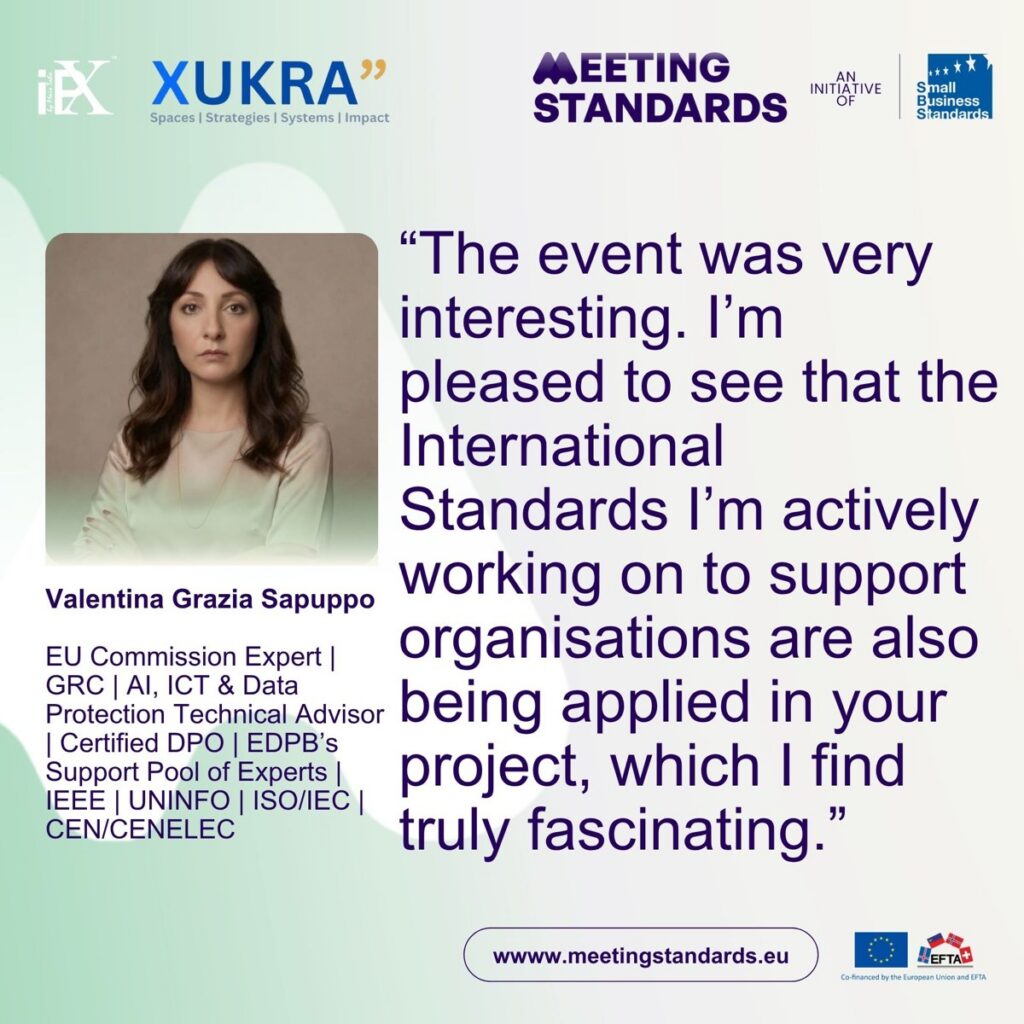
Testimonianza di Valentina Grazia Sapuppo per XUKRA, Meeting Standards 2026 TestimonianzaXUKRA” · Meeting StandardsValentina Grazia Sapuppo ha portato la sua testimonianza al workshop online di XUKRA” nell’ambito di Meeting Standards, l’iniziativa di Small Business Standards che avvicina le PMI europee alla normazione.30 giugno 2026, online · Meeting Standards, 4ª edizioneXUKRA”Meeting StandardsIniziativa europea di Small Business Standards - SBS
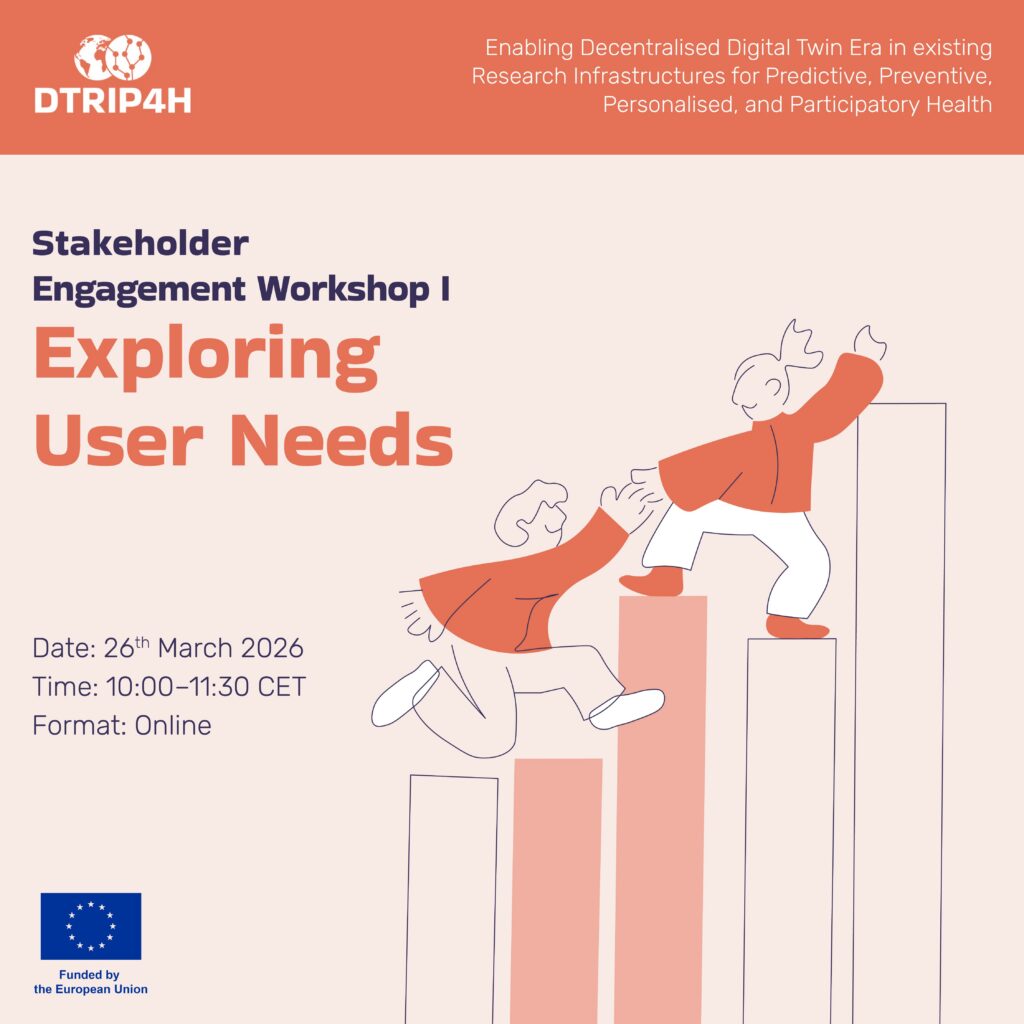
Locandina del workshop DTRIP4H Exploring User Needs, 26 marzo 2026PanelDTRIP4H · Gemelli digitali per la saluteValentina Grazia Sapuppo tra i main panellist del workshop «Exploring User Needs for DDTE: Ethics, Implementation, and the Future of Responsible Simulation» del progetto europeo DTRIP4H, con un intervento su governance, conformità e responsabilità. A giugno ha contribuito come esperto legale al workshop sui fabbisogni formativi.26 marzo e 23 giugno 2026, online · Horizon EuropeIl workshopLa registrazioneDTRIP4H
Intervista Radio Radio IntervistaLegge e colossi del digitaleIl patteggiamento di Meta sui minori non è una condanna. Stati Uniti ed Europa seguono strade opposte, e sugli agenti di IA resta aperta la domanda su chi risponde.Un Giorno Speciale su Radio Radio, con Alessio De Paolis · audio dal minuto 2:26:00Ascolta l’intervistaGuarda il videoLeggi l’articolo
Digital Omnibus ContributoIl Digital Omnibus cambia l’AI ActNuove scadenze per i sistemi ad alto rischio e un chiarimento sull’obbligo di AI literacy: più tempo per adeguarsi, nessuno sconto sulla preparazione di persone e processi.Articolo scritto per il blog di SkillaLeggi su Skilla
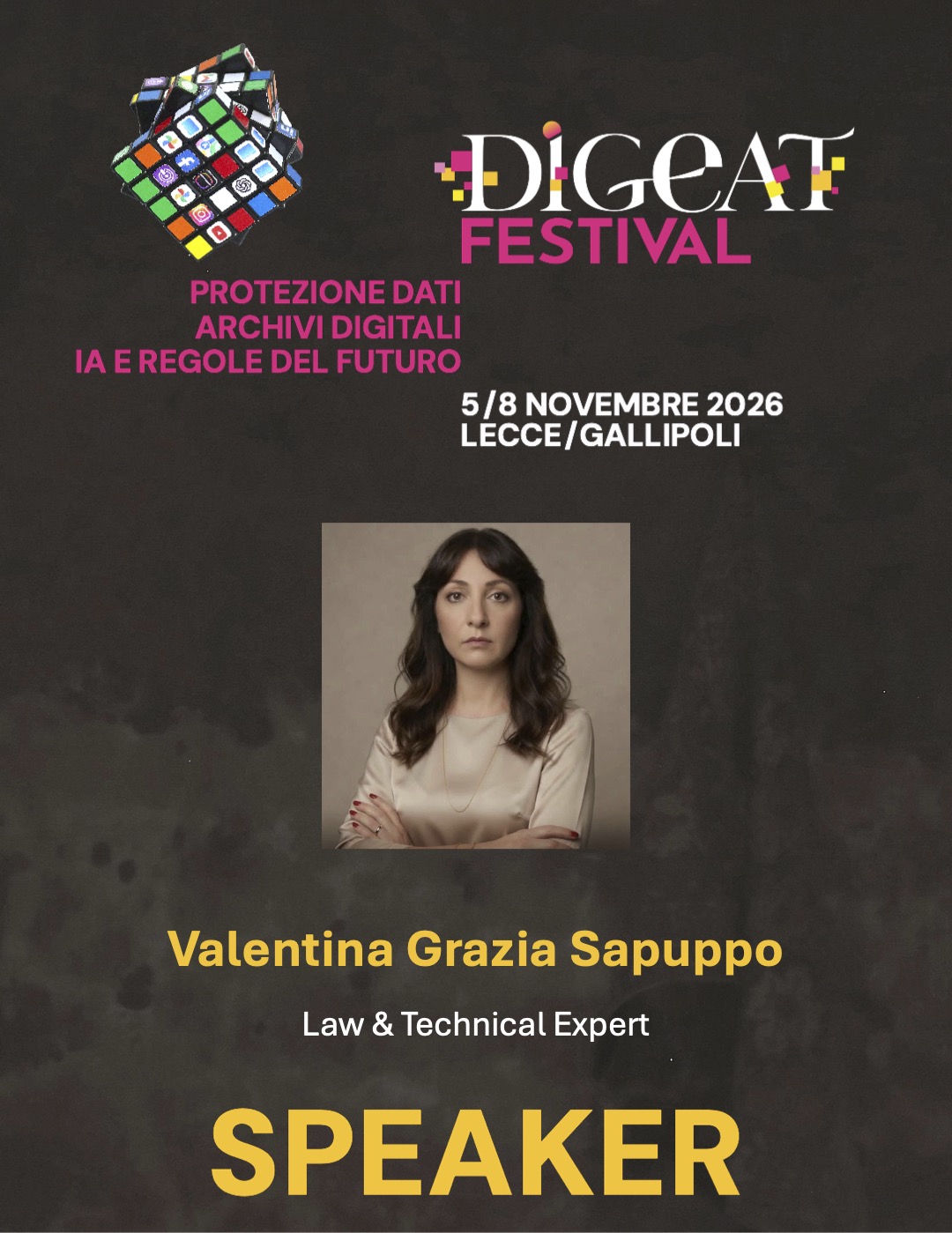
Digeat Festival 2026 SpeakerDigeat Festival 2026Valentina Grazia Sapuppo tra i relatori del festival dedicato a protezione dei dati, archivi digitali e regole del futuro. Interviene sul tema «Le regole dell’IA: nuove leggi o principi del diritto?».Venerdì 6 novembre 2026, ore 16:30, Ex Convitto Palmieri, LecceL’interventoLa scheda relatriceIl festival
AI AnthropoCosmic 2026AI AnthropoCosmic 2026Valentina Grazia Sapuppo nel progetto dell’Università Pontificia Salesiana su Persona, Ambiente e Cosmo: moderazione della sessione mattutina del Convegno finale e intervento negli AI Laboratori del Domani su commercio elettronico e IA.14 novembre 2026, online · 28 novembre 2026, Università Pontificia Salesiana, RomaIl convegnoL’incontroIl contributoIl comitato scientificoLa relatriceIl progetto
Testimony by Valentina Grazia Sapuppo for XUKRA, Meeting Standards 2026 TestimonyXUKRA” · Meeting StandardsValentina Grazia Sapuppo’s testimony for the XUKRA” online workshop, part of Meeting Standards, the Small Business Standards initiative bringing European SMEs closer to standardisation.30 June 2026, online · Meeting Standards, 4th editionXUKRA”Meeting StandardsEuropean initiative by Small Business Standards - SBS
Poster of the DTRIP4H workshop Exploring User Needs, 26 March 2026PanelDTRIP4H · Digital twins for healthValentina Grazia Sapuppo among the main panellists of the workshop “Exploring User Needs for DDTE: Ethics, Implementation, and the Future of Responsible Simulation” of the EU project DTRIP4H, speaking on governance, compliance and accountability. In June she contributed as a legal expert to the workshop on training needs.26 March and 23 June 2026, online · Horizon EuropeThe workshopThe recordingDTRIP4H
Interview Radio Radio InterviewLaw and the digital giantsThe Meta settlement on minors is not a conviction. The United States and Europe take opposite paths, and on AI agents the question of who answers remains open.Un Giorno Speciale on Radio Radio, with Alessio De Paolis · audio from 2:26:00 · in ItalianListen to the interviewWatch the videoRead the article
Digital Omnibus ContributionThe Digital Omnibus reshapes the AI ActNew deadlines for high-risk systems and a clarification on the AI literacy duty: more time to comply, no discount on preparing people and processes.Article written for the Skilla blog, in ItalianRead on Skilla
Digeat Festival 2026 SpeakerDigeat Festival 2026Valentina Grazia Sapuppo among the speakers of the festival on data protection, digital archives and the rules of the future. She takes part in the panel «The rules of AI: new laws or principles of law?».Friday 6 November 2026, 16:30, Ex Convitto Palmieri, LecceThe panelSpeaker profileThe festival
AI AnthropoCosmic 2026AI AnthropoCosmic 2026Valentina Grazia Sapuppo in the project of the Università Pontificia Salesiana on Person, Environment and Cosmos: moderator of the morning session of the closing conference and speaker at the AI Laboratori del Domani on e-commerce and AI.14 November 2026, online · 28 November 2026, Università Pontificia Salesiana, Rome · sessions held in ItalianThe conferenceThe sessionThe contributionThe scientific committeeSpeakerThe project