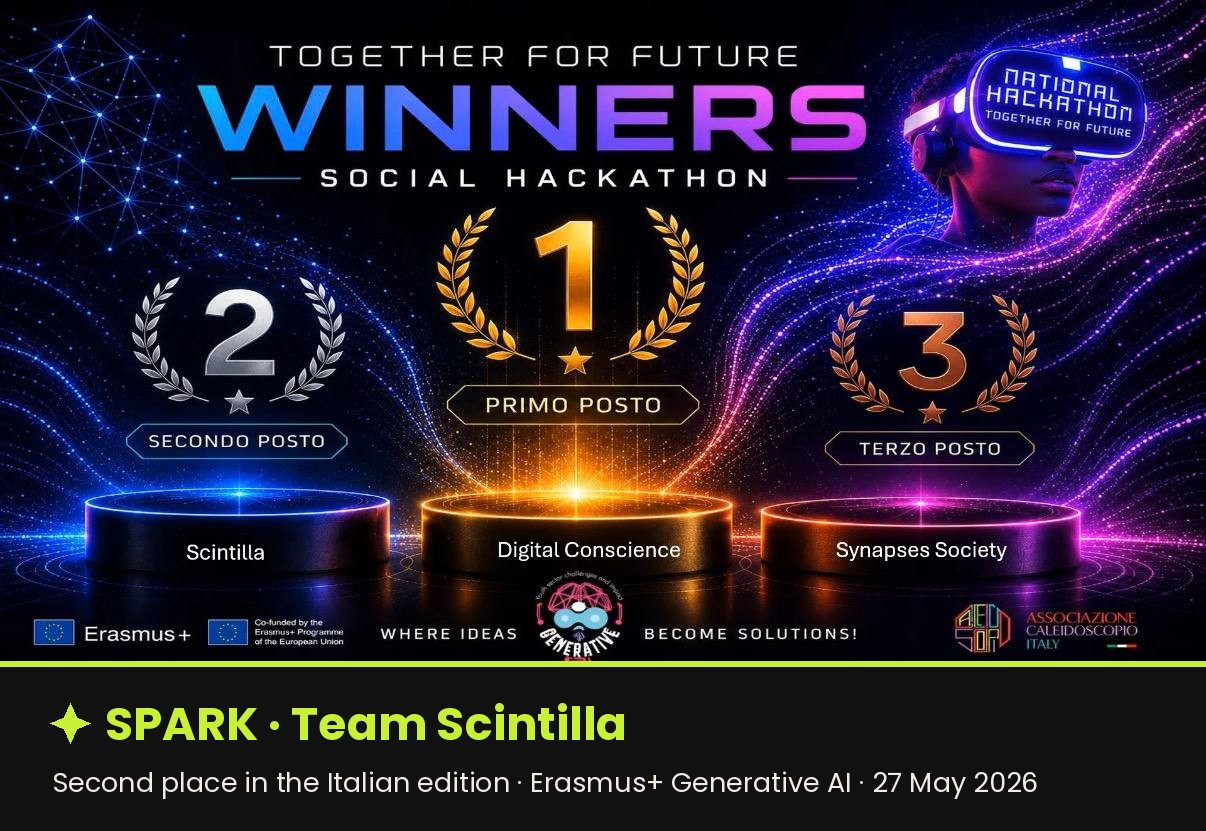
On 27 May 2026 the Italian edition of the Social Hackathon “Together for the Future” came to a close with an online pitch day. Organised by Associazione Caleidoscopio from 18 April under the Erasmus+ project “Generative AI - Youth Sector Challenges and Impact”, it brought together thirty participants in five teams, who spent several weeks, through online learning, Design Thinking and mentoring, on a shared theme, namely the ethical and inclusive use of artificial intelligence against online hate, discrimination and digital exclusion.
Team Scintilla, of which Valentina Grazia Sapuppo, the author of this blog, was a member, took second place with the SPARK project, behind Digital Conscience with SafeSpace AI and ahead of Synapses Society with DialogAI. Honourable mentions went to Echo Breakers and Team Sicerto. The jury brought together experts in technology, youth work, legal affairs and social impact. The teams selected in the national editions of the project’s six partner countries then met at the international final in Paola on 18 and 19 June 2026.
The SPARK project: a tool for the stage before the crisis
Most AI tools developed in this field step in once the harm has already occurred, by detecting hate speech, flagging false content or responding to a crisis. SPARK addresses the stage before, when a young person in a vulnerable situation has something to say about their neighbourhood, school or community but does not yet have the means to turn it into a voice that will be heard.
The tool guides users through a conversation of about five minutes, in Arabic, French, Italian or English, without requiring an account. Once an issue has been chosen and a few questions answered, the user’s reflections take the form of an editable story of change, which remains with its author and can be used in a workshop, in a post or in a message to a local official. The system does not write the text on the user’s behalf; it helps them bring out what they already know. Youth workers are given an aggregated, anonymous view of the themes raised by the group, so that sessions can be planned without access to any individual’s data.
SPARK, moreover, does not train or modify any model, since its behaviour depends on how the conversation is structured, which keeps it transparent and open to review.
The AI Act: transparency obligations and the prohibition on exploiting vulnerabilities
Within the team, Valentina Grazia Sapuppo was responsible for the legal aspects, presented in the part of the pitch devoted to safety by design. As regards Regulation (EU) 2024/1689 on artificial intelligence, the AI Act, in our view SPARK does not fall within the high-risk systems listed in Annex III, as it neither assesses learning outcomes nor determines access or admission to education. The transparency obligations in Article 50 do apply, starting with informing users that they are interacting with an AI system.
The project also takes account of the prohibition, laid down in Article 5(1)(b), on exploiting the vulnerabilities of a person due to their age, disability or a specific social or economic situation, and provides for human review of outputs.
The GDPR: data protection by design and users who are minors
As regards the General Data Protection Regulation (GDPR), data protection by design and by default under Article 25 and the principle of data minimisation in Article 5(1)(c) translate into concrete choices, such as the absence of accounts, no retention of data beyond the session, no profiling, and a view for educators limited to aggregated trends. The decision to launch in four languages likewise reflects the need for equal access, in line with the prohibition of discrimination in Article 21 of the Charter of Fundamental Rights of the European Union.
Should the project be developed further, we believe that the legal basis for processing will need to be defined and the age of digital consent taken into account, which Article 2-quinquies of the Italian Personal Data Protection Code sets at fourteen, given that a significant share of the intended users are minors.
Conclusions
The Social Hackathon experience confirms that compliance with the AI Act and the GDPR works best when it is part of a project from its earliest conception, alongside design and technical choices, rather than a check carried out at the end. SPARK is still a concept; the need it addresses is, however, documented and the technology required to build it is already available. Will tools designed to strengthen the voice of the most vulnerable young people find room within European programmes to move from idea to pilot?
Author: Valentina Grazia Sapuppo