'/%3E%3C/svg%3E)
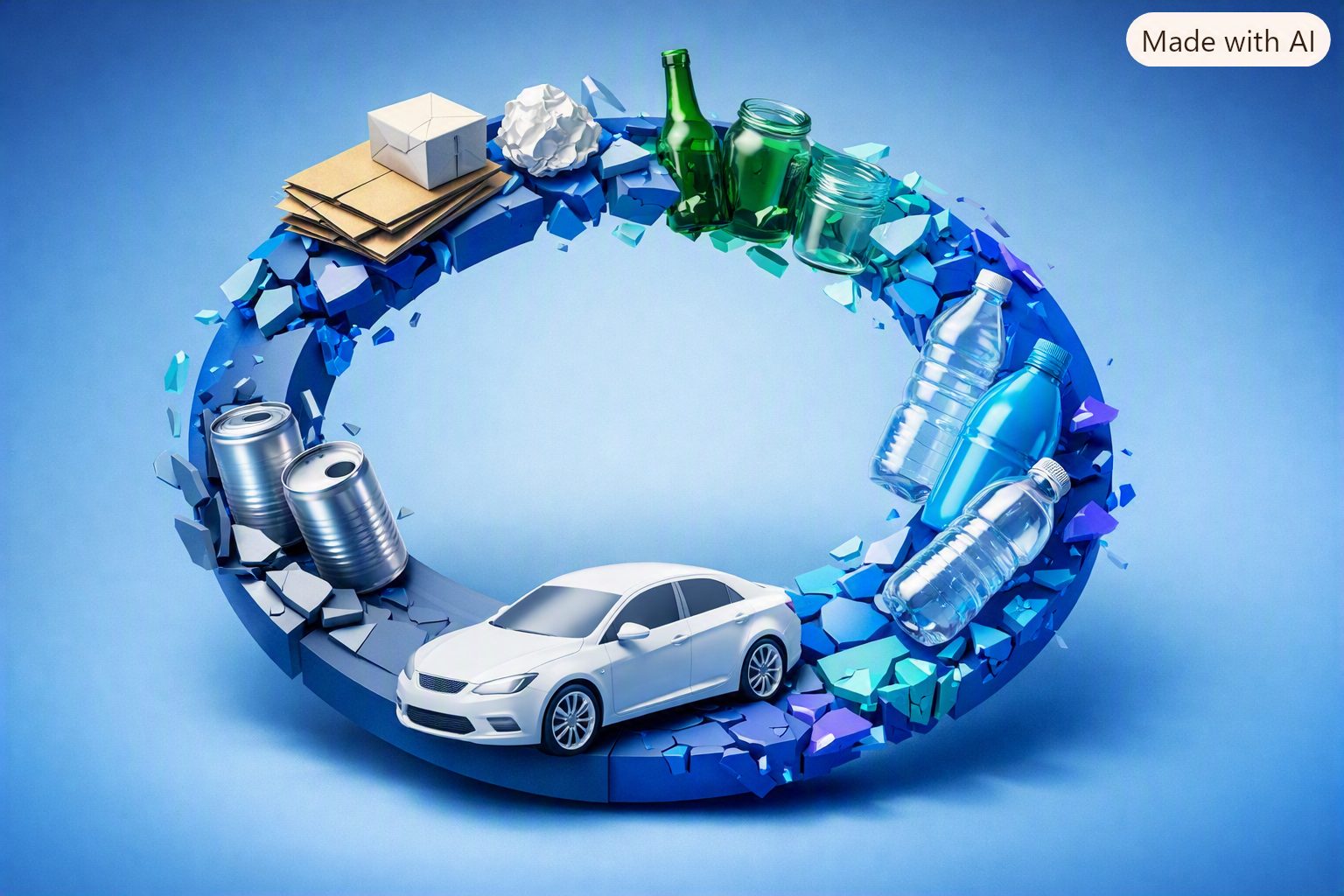
In August 2026 the European Union’s circular economy legislation passed two milestones: Regulation (EU) 2025/40 on packaging and packaging waste applies from 12 August 2026, and Regulation (EU) 2026/1738 on circularity requirements for vehicle design and on the management of end-of-life vehicles entered into force on 13 August 2026. This contribution gathers the main references, without any claim to completeness.
The Packaging and Packaging Waste Regulation: application from 12 August 2026
Regulation (EU) 2025/40 of the European Parliament and of the Council of 19 December 2024 on packaging and packaging waste (Packaging and Packaging Waste Regulation, PPWR) repeals Directive 94/62/EC and replaces fragmented national requirements with a harmonised framework covering the entire packaging life cycle in the Single Market. The Regulation entered into force in February 2025 and applies on a phased basis from 12 August 2026, as recalled by the European Commission in a news item published on 11 August 2026.
Its stated objectives are four: stopping the trend of ever increasing packaging waste, improving the functioning of the internal market, fostering efficiency in the waste value chain and promoting the circular economy. According to the estimates recalled by the Commission, without action packaging waste in the EU was projected to grow by 19% by 2030, and plastic packaging waste by as much as 46%. The Regulation is also presented as a tool to reduce dependence on imports of virgin materials and to strengthen the market for secondary raw materials, on the path towards climate neutrality by 2050.
The restriction of PFAS in food-contact packaging
The main measure that became applicable on 12 August 2026 concerns per- and polyfluoroalkyl substances (PFAS) in food-contact packaging: packaging containing PFAS above the limits set by the Regulation can no longer be placed on the EU market. PFAS, highly persistent substances that can accumulate in the environment and in the human body, have long been used in takeaway containers, food wrappers, microwave popcorn bags, bakery paper and pizza boxes for their water-repellent and grease-repellent properties. The restriction is designed to reduce human exposure and the release of these substances into the environment.
In March 2026 the Commission published a guidance document on the implementation of the Regulation, with practical information for businesses, national authorities and other stakeholders, including on the application of the new PFAS restrictions.
The timetable of measures: labelling from 2028 and the 2030 objectives
The application of the Regulation is phased over time. From 2028 a harmonised packaging labelling system will apply across the EU, intended to facilitate waste sorting and to increase efficiency in the recycling and composting streams. From 2030 the waste reduction measures will apply, including limits on empty space in packaging, restrictions on certain single-use plastic packaging and reuse targets. Also from 2030, the circularity measures will become operational, with the mandatory use of recycled plastic in new plastic packaging and the requirement that all packaging is recyclable.
The Commission has indicated that the secondary legislation needed for implementation is being prepared, with the stated aim of ensuring that it is effective without creating unnecessary administrative burden, in cooperation with national authorities, industry and civil society.
The End-of-Life Vehicles Regulation: circularity requirements in design
On 13 August 2026 Regulation (EU) 2026/1738 of the European Parliament and of the Council of 8 July 2026 on circularity requirements for vehicle design and on management of end-of-life vehicles entered into force, repealing Directive 2000/53/EC on end-of-life vehicles, adopted in 2000, and Directive 2005/64/EC on the type-approval of motor vehicles with regard to their reusability, recyclability and recoverability, adopted in 2005.
The Regulation encourages vehicle design that makes dismantling, reuse, recycling and recovery easier, and improves the information available on the removal and replacement of components during use and at the end of a vehicle’s life. It sets mandatory recycled content targets for plastics in new vehicles of 15% from 2032 and 25% from 2036; the Commission will also establish recycled content targets for steel and aluminium, which should apply from 2033. Measures are introduced to foster a higher recovery of critical raw materials from end-of-life vehicles, in particular aluminium, copper and rare earth elements, and to strengthen the collection and traceability of vehicles reaching the end of their life, with clearer criteria distinguishing used vehicles from end-of-life vehicles.
From mid-2031 only roadworthy vehicles may be exported outside the EU, to prevent end-of-life vehicles from leaving the Union as second-hand vehicles. Extended Producer Responsibility is strengthened, so that producers contribute to the costs of collecting and treating end-of-life vehicles, and the framework is extended to additional vehicle categories, including lorries, buses and motorcycles.
The Eurostat figures on packaging waste
According to the figures released by Eurostat on 22 October 2025, in 2023 the European Union generated 79.7 million tonnes of packaging waste, or 177.8 kg per inhabitant: 8.7 kg less than in 2022, but 21.2 kg more than in 2013. Paper and cardboard accounted for 40.4% of packaging waste, plastic for 19.8%, glass for 18.8%, wood for 15.8% and metal for 4.9%.
Plastic packaging waste averaged 35.3 kg per person, of which 14.8 kg were recycled. The EU recycling rate for plastic packaging stood at 42.1%, up from 38.2% in 2013; the highest rates were recorded in Belgium (59.5%), Latvia (59.2%) and Slovakia (54.1%), the lowest in Hungary (23.0%), France (25.7%) and Austria (26.9%).
Outlook
The application timetable of the two Regulations extends into the next decade. For packaging, the secondary legislation being prepared by the Commission is awaited, together with harmonised labelling from 2028 and the measures on reduction, reuse, recycled content and recyclability from 2030. For vehicles, the recycled content targets for plastics will apply from 2032 and 2036, the rule allowing the export of roadworthy vehicles only from mid-2031, while the targets for steel and aluminium expected to apply from 2033 remain to be defined through Commission acts. Implementation will involve national authorities, producers and waste management operators.
In dialogue with the 2030 Agenda
- Goal 12 (Responsible consumption and production). The two Regulations act on the design, reuse and recycling of packaging and vehicles, reducing waste generation and keeping materials in use for longer.
- Goal 3 (Good health and well-being). The restriction of PFAS in food-contact packaging reduces human exposure to persistent chemicals.
- Goal 9 (Industry, innovation and infrastructure). The market for secondary raw materials and investment in recycling capacity strengthen the resilience of Europe’s industrial base.
- Goal 13 (Climate action). Reducing waste and using recycled materials contribute to the Union’s path towards climate neutrality by 2050.
Sources
- European Commission, New EU packaging rules start to apply (11 August 2026)
- European Commission, New rules for a more circular European automotive sector (12 August 2026)
- Regulation (EU) 2025/40 (EUR-Lex)
- Regulation (EU) 2026/1738 (EUR-Lex)
- European Commission, Packaging and Packaging Waste Regulation
- European Commission, End-of-Life Vehicles
- Eurostat, Plastic packaging waste in the EU: 35.3 kg per person (22 October 2025)