


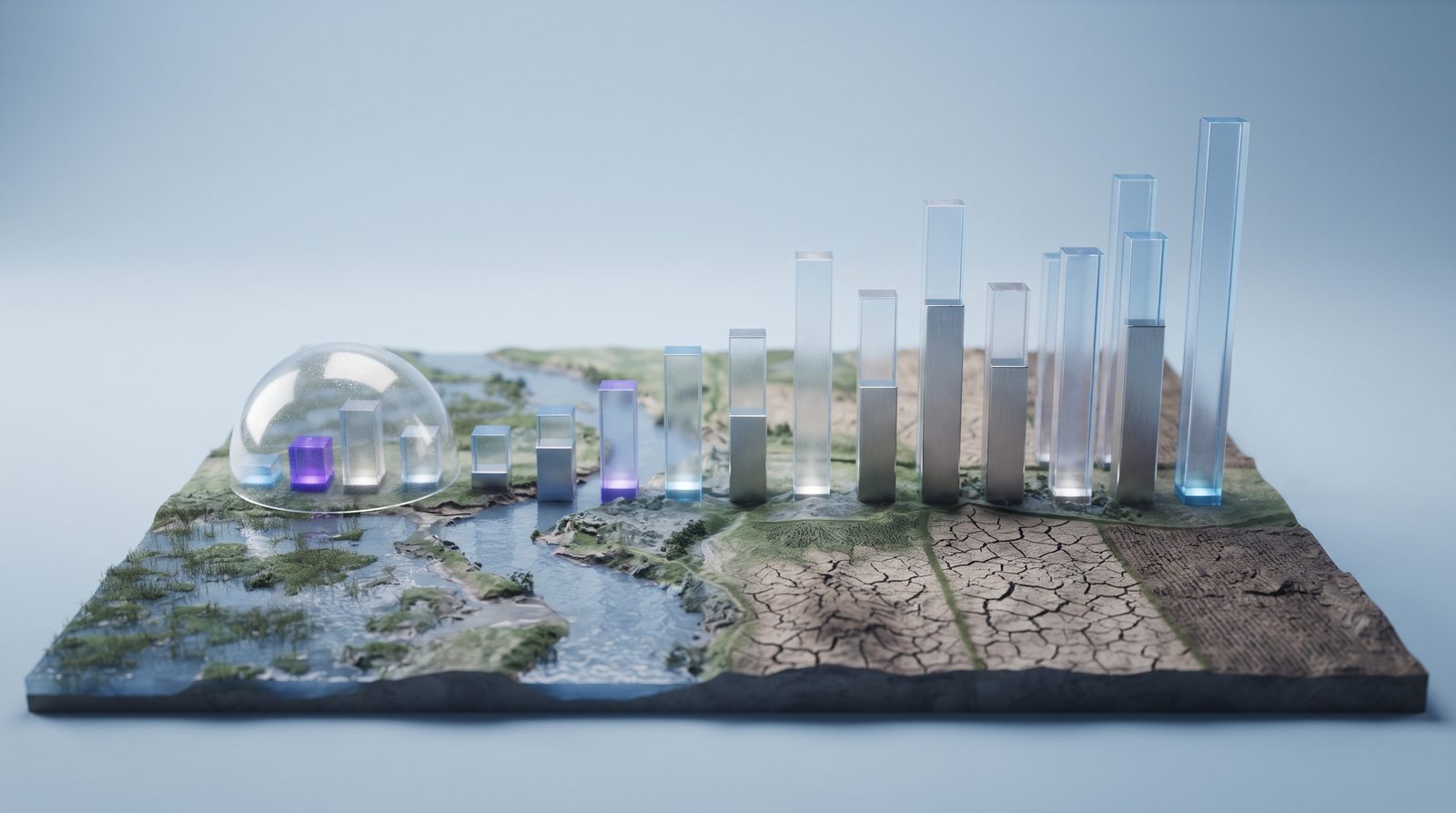
On 16 November 2026 the European Environment Agency (EEA) published the update of its indicator on economic losses from weather- and climate-related extremes in Europe. The data cover 1980-2025. According to the EEA, the last five years are those with the highest losses since 1980, while the gap between losses suffered and losses insured remains wide.
The scale of losses
Between 1980 and 2025 extreme events caused economic losses in the European Union estimated at around EUR 920 billion, of which more than EUR 270 billion in the last five years. Almost a third of the losses recorded over 45 years occurred between 2021 and 2025. The values cover direct losses only, at 2025 prices. They do not include indirect losses such as reduced productivity or gross domestic product, or impacts on the environment and on people’s health.
Average annual losses rose from around EUR 8.8 billion in 1980-1989 to EUR 48.2 billion in 2020-2025, a period covering only six years. According to the EEA, around half of the increase between 2009 and 2025 can be linked to growing wealth and exposure, and losses have grown twice as fast as gross domestic product. The EEA notes that analysing trends remains challenging because of large year-to-year variability.
According to the EEA, 2026 is also a year of heavy losses, driven by storms, heatwaves and droughts, and the year is not over yet. The European Commission reports preliminary data indicating that the 2026 heatwaves caused more than 35,000 deaths and, based on a study by Allianz, EUR 113 billion in output losses. Output losses are indirect losses, which the EEA indicator does not cover.
Types of events and geographical distribution
Floods account for 44% of losses over 1980-2025. Climatological events (drought, cold spells and frost, excluding heatwaves and wildfires) and meteorological events (storms and lightning, excluding hail) account for about a quarter each. Wildfires, hail and heatwaves together account for around 5% of direct losses. Losses are highly concentrated. The 5% most damaging events caused 63% of losses and 1% of events caused 31%.
In absolute terms the highest losses were recorded in Germany, Italy and France. Per capita, the highest values concern Slovenia, Spain and Luxembourg; per area, Slovenia, Belgium and Luxembourg.
The insurance protection gap
Over 1980-2025 less than 20% of losses in the European Union were insured. The share varies widely between Member States, from less than 2% in Bulgaria, Cyprus and Romania to over 60% in Denmark and Luxembourg. Coverage also varies by type of event. Over 35% of losses from meteorological events (including hail) were insured, compared with 15% for hydrological events and under 10% for climatological events, including heatwaves, wildfires, droughts, cold spells and frost. According to the indicator, recurring damage creates barriers to insurance adoption and losses put pressure on public finances.
Projections and the European framework
The first European Climate Risk Assessment (EUCRA), referred to by the EEA, concluded that climate risks are accelerating and that adaptation is not keeping pace. It estimates losses of at least EUR 175 billion a year for the European Union and the United Kingdom at 3°C of global warming. Future costs will depend on the frequency and severity of events, the value of exposed assets and the effectiveness of adaptation measures.
On policy, the EEA refers to the 2021 EU Adaptation Strategy and the EU Framework for Climate Resilience, presented by the European Commission on 27 October 2026 with Communication COM(2026) 720. The Framework includes the proposal for a European Climate Resilience Law, COM(2026) 730, and a set of practical tools. It provides for a common reference trajectory for global warming to inform decisions on policies, assets and investments, the identification of policy risk owners, a single strategic plan for Member States and simplified monitoring. According to the Commission, scientific evidence points to warming of 1.5°C above pre-industrial levels by 2030, 2°C by 2050 and 3°C by 2100. There are three digital tools, the European Climate Viewer, the Navigator of Climate Resilience Tools and the Mission Solutions Explorer. The Commission estimates that adapting infrastructure and the economy to future climate conditions will require investment of around EUR 70 billion a year.
Outlook
The proposal for a European Climate Resilience Law now has to be examined by the European Parliament and the Council. The final content of the planning obligations for Member States and of the reference trajectory remains to be settled during the legislative process. On insurance, the Commission has announced a Climate Insurance Alliance, which will be presented separately and whose content is not yet known.
The EEA indicates that losses are likely to keep rising as extreme events intensify, and that the European framework aims to move from reacting to disasters to anticipating impacts and preventing avoidable damage. The indicator is updated once a year. Between 1980 and 2025 more than 80% of losses were uninsured.
In dialogue with the 2030 Agenda
- Goal 13. Climate action. Target 13.1 concerns strengthening resilience and adaptive capacity to climate-related hazards and natural disasters. The EEA indicator is used by Eurostat to monitor Goal 13 in the European Union.
- Goal 11. Sustainable cities and communities. Target 11.5 concerns reducing deaths, the number of people affected and direct economic losses caused by disasters, including water-related disasters; indicator 11.5.2 measures direct economic loss in relation to global gross domestic product. Floods account for 44% of the losses recorded by the EEA.
- Goal 1. No poverty. Target 1.5 concerns building the resilience of the poor and those in vulnerable situations and reducing their exposure to climate-related extreme events. The EEA also links its indicator to this Goal. The insured share of losses ranges from less than 2% in Bulgaria, Cyprus and Romania to over 60% in Denmark and Luxembourg.
Sources
- EEA, Climate-related losses in the EU are rising fast: the last five years were the costliest on record, press release, 16 November 2026
- EEA, Economic losses from weather- and climate-related extremes in Europe, indicator, 16 November 2026
- European Commission, EU Framework for Climate Resilience, page updated on 26 October 2026
- European Commission, Commission presents Climate Resilience Framework for a better prepared and protected Europe, press release IP/26/2244, 27 October 2026
- European Commission, Forging a climate-resilient Europe. The new EU Strategy on Adaptation to Climate Change, COM(2021) 82
- United Nations, Sustainable Development Goals