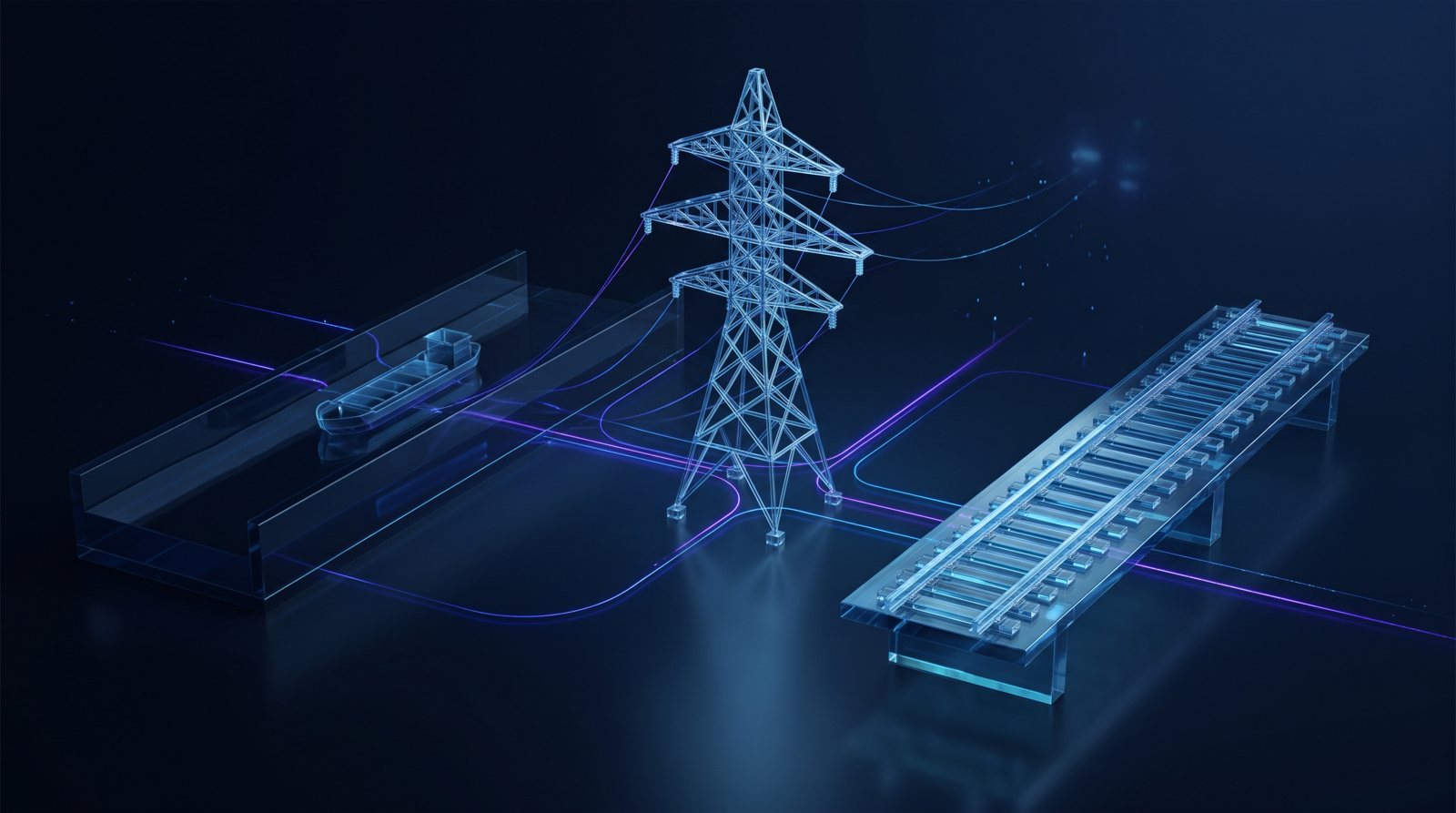
On 3 November 2026 the European Environment Agency (EEA) published Briefing no. 22/2026 Europe’s critical infrastructure under climate stress: lessons from 2026. Using documented cases, the briefing looks at how drought, extreme heat, wildfires and storms in 2026 affected critical transport and energy infrastructure in Europe.
Scope of the briefing
The briefing is not a complete assessment. It draws on documented case studies to illustrate risk pathways identified in the European Climate Risk Assessment (EUCRA), which the EEA published on 11 March 2024 as Report no. 01/2024. EUCRA identifies 36 climate risks, concerning energy and food security, ecosystems, infrastructure, water resources, financial stability and human health.
The analysis focuses on the transport and energy sectors as defined in Directive (EU) 2022/2557 of the European Parliament and of the Council of 14 December 2022 on the resilience of critical entities (Critical Entities Resilience Directive, CER Directive). The EEA’s accompanying press release reports that extreme heat, amplified by climate change, cost the European Union at least 1% of its gross domestic product (GDP) in 2026; the briefing takes this figure from an external estimate. The press release adds that adaptation needs to speed up if infrastructure is to keep pace with the changing climate.
Key figures
At the end of July 2026 drought was affecting roughly half of the territory of the European Union and the United Kingdom. According to a Joint Research Centre (JRC) estimate cited in the briefing, the energy sector accounts for about 23% of drought-related economic losses in Europe, around EUR 2 billion a year. During heatwaves, daily electricity demand increased by up to 25% in some countries.
The briefing also refers to cascading effects across sectors: according to EUCRA, about 60% of power grid failures and 24% of telecommunications failures led to disruption in other sectors. In rail transport, heatwaves caused more than 20,000 hours of delay in Europe between 2015 and 2024, according to data from the European Union Agency for Railways (ERA). In Spain, wildfires in July and August 2026 led to the closure of 2,640 kilometres on 227 roads.
As for long-term projections, modelling cited by EUCRA puts the expected annual damage to European critical infrastructure at EUR 3.4 billion in the 2000s. This could increase to EUR 9.3 billion in the 2020s, EUR 19.6 billion in the 2050s and EUR 37 billion in the 2080s. According to EUCRA, these figures could significantly underestimate the actual damage. The briefing presents them as long-term context and not as estimates of damage in 2026.
Three case studies: the Rhine, Portugal and the Danube
The first case concerns drought on the Rhine in Germany. On 14 August 2026 the water level at Kaub dropped below 10 centimetres, against a previous low of about 25 centimetres recorded in 2018. By the end of July, vessels passing Kaub were often sailing at about 20% of their capacity, with around 250 tonnes on board. Freight rates from the Amsterdam-Rotterdam-Antwerp area to Basel went from about EUR 35 to EUR 277 per tonne by mid-August. According to an estimate by the German construction industry cited in the briefing, replacing a single barge may take as many as 150 lorries.
The second case is Storm Kristin, which struck Portugal on 28 January 2026 with winds of up to about 200 km/h. More than one million customers were left without electricity. Sixty-one very high voltage pylons collapsed, and 774 kilometres of lines, about 7% of the national transmission grid, were put out of service. There were also 345 road closures and disruption on 11 railway sections. Portugal’s Insurance and Pension Funds Supervisory Authority (ASF) estimated total economic damage at EUR 5.3 billion, of which only 26% was insured.
In summer 2026 continental Europe’s interconnected electricity system remained stable, despite generation constraints in several countries, thanks to cross-border coordination and the single electricity market. Cyprus, the only Member State with a fully isolated power system, instead introduced scheduled power cuts in July 2026.
The third case concerns low flows on the Danube in Romania and Hungary. On 28 July the flow at Baziaș was 1,650 cubic metres per second, roughly a third of the July multiannual average. At Cernavodă, whose two reactors normally supply 20% of Romania’s electricity generation, Unit 1 was taken offline from 27 July and Unit 2 began a controlled shutdown on 13 August. Romania declared a state of emergency on 31 July, initially for 30 days, and later extended it to the end of September. In Hungary the Paks plant, which generates about 40% of the country’s electricity, had to reduce output on several occasions.
The briefing’s lessons and the EU framework
The briefing sets out six lessons. The first is to take future climate conditions, and not only historical records, into account when appraising, designing and maintaining assets, in line with a resilience by design approach. The second is to carry out system-wide assessments covering networks, interdependencies, supply chains and cross-border effects. The third is to conduct periodic stress tests in order to identify vulnerabilities and set investment priorities. The fourth is to test, across sectors, alternative routes, backup systems, early warning and agreed emergency measures. The fifth is to strengthen coordination between operators, regulators, authorities and emergency services. The sixth is to combine incremental and transformational adaptation.
On the regulatory side, the CER Directive set 17 October 2024 as the transposition deadline and required Member States to identify critical entities by 17 July 2026. On design, the briefing refers to Commission Notice 2021/C 373/01, Technical guidance on the climate proofing of infrastructure in the period 2021-2027. On 27 October 2026 the European Commission presented the EU framework for climate resilience, COM(2026) 720, and the proposal for a European climate resilience law, COM(2026) 730. According to the Commission, the proposal is intended to give public authorities, businesses and communities a shared, more proactive and systemic way of managing climate risks.
Outlook
The proposed European climate resilience law has yet to complete the legislative process, and its final text is not yet known. The Commission has announced further initiatives without giving dates. These are a European heatwave plan, a climate insurance alliance, a European water initiative, a PreparEU advisory group on disaster preparedness and an initiative to identify Europe’s 100 most climate-vulnerable territories.
We consider that two aspects deserve attention. The first concerns the relationship between the resilience measures of critical entities under the CER Directive and the future climate conditions referred to by the EEA. The second concerns insurance cover for infrastructure damage, which in the Portuguese case stopped at 26% of economic losses. Will Member States and critical entities, in the risk assessments required by the CER Directive, take account of climate conditions that historical data no longer describe?
In dialogue with the 2030 Agenda
- Goal 9. Industry, innovation and infrastructure. Target 9.1 concerns quality, reliable, sustainable and resilient infrastructure; the briefing documents the vulnerability of transport and energy networks to the climate events of 2026.
- Goal 13. Climate action. Target 13.1 concerns strengthening resilience and adaptive capacity to climate-related hazards; the EEA lessons on stress tests and future climate scenarios fall within this area.
- Goal 11. Sustainable cities and communities. Target 11.5 includes reducing direct economic losses caused by disasters, including water-related disasters; indicator 11.5.3 measures damage to critical infrastructure and disruptions to basic services. The Portuguese case gives a measure of this, with damage estimated at EUR 5.3 billion.
Sources
- EEA, Briefing 22/2026, Europe’s critical infrastructure under climate stress: lessons from 2026, 3 November 2026
- EEA, press release of 3 November 2026: What climate extremes of 2026 teach Europe about resilient infrastructure
- EEA, European Climate Risk Assessment (EUCRA), Report 01/2024, 11 March 2024
- EUR-Lex, Directive (EU) 2022/2557 on the resilience of critical entities
- European Commission, Protecting Europe with stronger climate-resilience, 27 October 2026
- European Commission, press release IP/26/2244 on the EU climate resilience framework, 27 October 2026