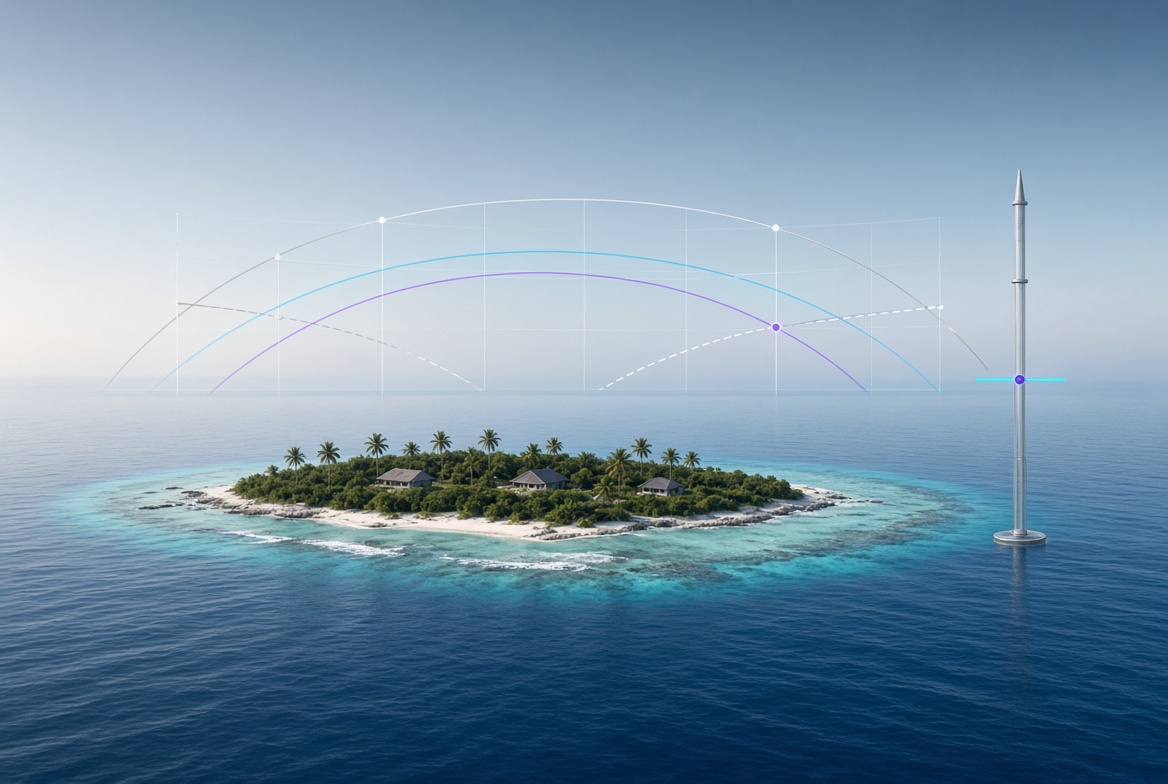
On 24 September 2026, during the high-level week of the 81st session of the United Nations General Assembly, the second high-level plenary meeting on sea level rise took place. Its outcome is a declaration negotiated among States and agreed by consensus, structured in four pillars and also addressing the legal questions of the stability of maritime zones and the continuity of statehood.
The path to the meeting of 24 September 2026
The meeting was convened under General Assembly decision 78/558 of 1 August 2024, which provided for a one-day plenary on sea level rise no later than the last day of the general debate of the 81st session. The decision states that the meeting is to result in a concise, action-oriented, intergovernmentally negotiated declaration agreed by consensus, without setting a precedent for similar meetings. The first high-level meeting on the subject was held on 25 September 2024.
On 5 December 2025 the President of the General Assembly appointed the Permanent Representatives of Australia, James Martin Larsen, and Cabo Verde, Tania Serafim Yvonne Romualdo, as co-facilitators of the negotiations. Between mid-March and mid-April 2026 the United Nations Department of Economic and Social Affairs (DESA) ran an online stakeholder consultation that gathered 1,072 responses across four thematic areas. On 22 May 2026 the Secretary-General issued report A/81/74 on the challenges related to sea level rise. The final draft declaration, agreed under silence procedure, was transmitted to Member States on 20 August 2026; the advance unedited version of the text is available on the United Nations Sustainable Development Goals portal.
Reference data
According to the United Nations, nearly 900 million people live in low-lying coastal zones and more than one billion could be exposed by 2050. The rate of global mean sea level rise in 2014-2023 was more than twice the rate recorded in the first decade of satellite measurements, 1993-2002. Based on estimates of the Intergovernmental Panel on Climate Change (IPCC), sea levels are expected to rise by 15 to 30 centimetres on average by 2050.
For 2100 the World Meteorological Organization (WMO) estimates a rise of at least half a metre, while the most pessimistic projections cited in report A/81/74 reach two metres. For Pacific States such as Tuvalu, Kiribati and the Marshall Islands, much of whose territory lies around two metres above sea level, the exposure concerns the habitability of the territory itself. The impacts listed in the declaration include flooding, loss of land, salinisation of arable land and freshwater, coastal erosion and an increased risk of waterborne disease.
The four pillars of the Declaration
The first pillar concerns knowledge, data and science. The text refers to the work of the IPCC, the Intergovernmental Science-Policy Platform on Biodiversity and Ecosystem Services (IPBES) and the Regular Process for Global Reporting and Assessment of the State of the Marine Environment, as well as traditional and Indigenous knowledge. It acknowledges the data coordination provided by the WMO and the Intergovernmental Oceanographic Commission of UNESCO and commits to strengthening observation, data collection and modelling, including bathymetric, topographical and satellite data, the Global Ocean Observing System and the Global Sea Level Observing System, together with multi-hazard early warning systems.
The second pillar is devoted to adaptation, finance and resilience. The declaration calls for enhanced public and private finance for developing countries, particularly Small Island Developing States (SIDS) and Least Developed Countries, streamlined access procedures and timely, predictable disbursement. It points to nature-based solutions such as the protection of mangroves, coral reefs, coastal wetlands, kelp forests and seagrass meadows, and calls for sea level rise projections to be integrated into the design of critical infrastructure, including ports, energy, transport, water systems, healthcare facilities, telecommunications and digital infrastructure.
The third pillar addresses livelihoods, socioeconomic challenges, culture and heritage. The text calls for risks to be integrated into social protection and development planning, supports voluntary choices by affected communities and mobility with dignity consistent with international law, and calls for the full participation of women, youth, persons with disabilities, Indigenous Peoples and local communities in decision-making. The protection and documentation of cultural heritage, including through digitisation, is identified as a priority.
The legal dimension: maritime zones, statehood and protection of persons
The fourth pillar states that international law provides the foundation for action and underlines the need for legal stability, certainty and predictability. The declaration notes the Advisory Opinion of the International Court of Justice on the obligations of States in respect of climate change, delivered on 23 July 2025, and the final report of the Study Group of the International Law Commission on sea-level rise in relation to international law.
On maritime zones, the text affirms that, once established in accordance with the United Nations Convention on the Law of the Sea (UNCLOS), States can maintain them despite physical changes caused by sea level rise, without prejudice to their ability to update them. On statehood, it recalls that the disappearance of one of the constituent elements of a State does not necessarily entail the loss of its statehood and affirms a presumption in favour of continuity, extending to sovereignty, sovereign rights and membership of the United Nations. For affected persons, it stresses the duty of States to respect, protect and fulfil human rights and encourages international cooperation.
Some States have already adopted specific solutions. In 2022 Tuvalu announced its “digital nation” project, which envisages moving government functions into a digital space, a three-dimensional scan of its islands and the digital archiving of its cultural heritage. The Falepili Union Treaty, concluded in 2023 between Tuvalu and Australia, recognises the continuing statehood of Tuvalu and creates a dedicated visa pathway for its citizens.
Outlook
The declaration acknowledges that the United Nations Framework Convention on Climate Change and the Paris Agreement remain the primary forums for the global response to climate change and calls for existing instruments not to be duplicated. As follow-up, it provides for dialogue at the highest level, the mainstreaming of the issue into all relevant processes and a further high-level meeting before the end of the 84th session of the General Assembly, with scope and modalities to be decided no later than the 83rd session. The scale of financial resources to be mobilised, the mechanisms for reviewing commitments and the official edited version of the text remain to be defined.
In dialogue with the 2030 Agenda
Goal 13. Climate action: the declaration links sea level rise to ocean warming and the melting of ice and refers to adaptation, mitigation and early warning systems.
Goal 14. Life below water: the text refers to UNCLOS, the stability of maritime zones and the protection of coastal and marine ecosystems such as mangroves, coral reefs and seagrass meadows.
Goal 11. Sustainable cities and communities: the declaration calls for sea level rise projections to be integrated into the planning of critical infrastructure and for cultural heritage to be protected, including through digitisation.
Goal 16. Peace, justice and strong institutions: the fourth pillar concerns legal certainty, continuity of statehood, the maintenance of institutional functions and the protection of the human rights of affected persons.
Sources
- Office of the President of the UN General Assembly, High-level Meeting to Address the Existential Threats Posed by Sea-level Rise, 24 September 2026
- United Nations, DESA, Sea-Level Rise Declaration 2026
- United Nations, UN Declaration on Sea Level Rise, advance unedited version
- UN Secretary-General, A/81/74, Challenges related to sea level rise and ways and approaches to address it, 22 May 2026
- UN General Assembly, Decision 78/558, Enhancing action on sea level rise (A/78/L.101), 1 August 2024
- United Nations, Focus: Sea level rise
- UN News, The world comes to New York: What’s at stake this General Assembly High-Level Week, 16 September 2026
- UN News, When a country goes underwater: Island States fight for their future, 22 September 2026