

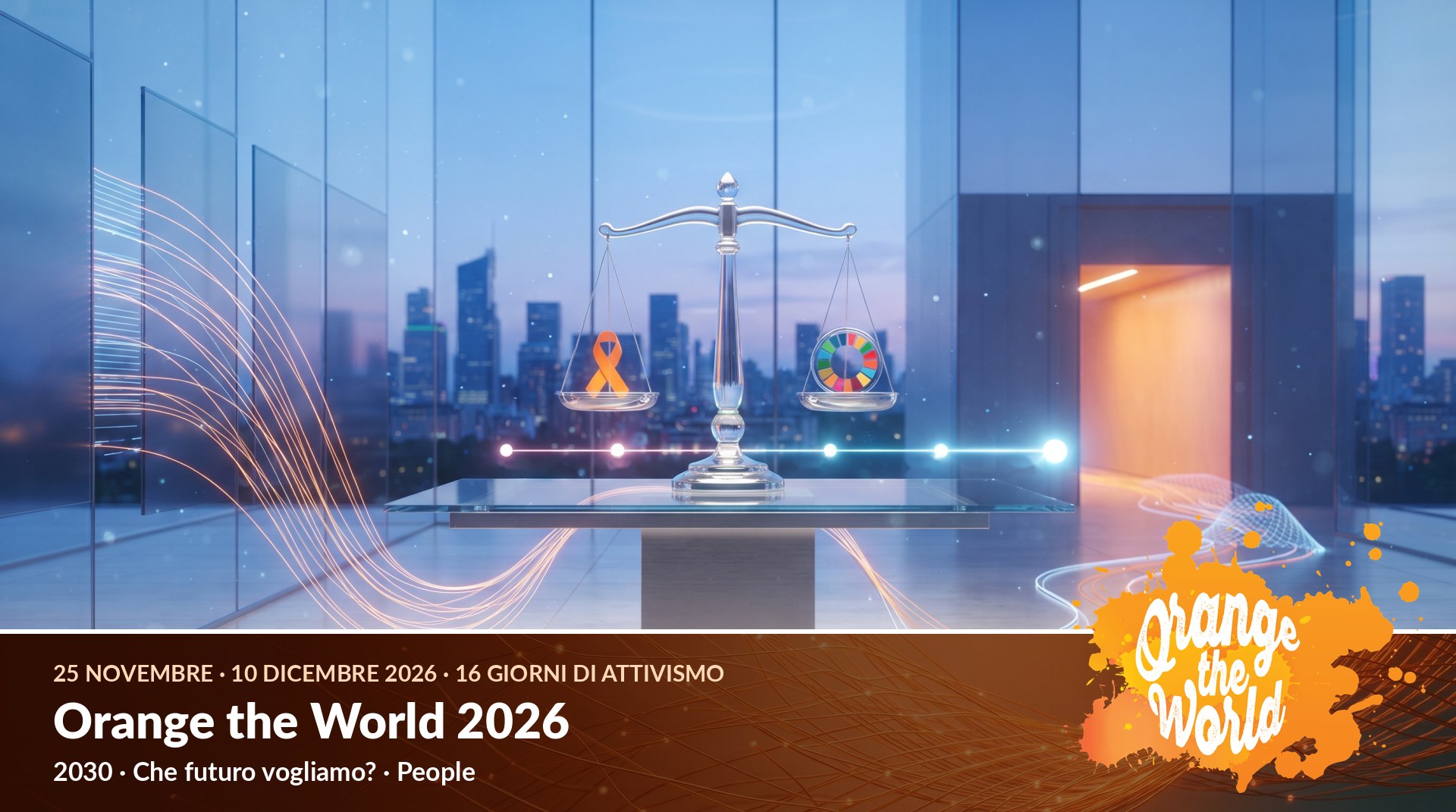
From 25 November, the International Day for the Elimination of Violence against Women, to 10 December, International Human Rights Day, the 16 Days of Activism against Gender-Based Violence take place. For 2026 the UNiTE campaign of the Secretary-General of the United Nations (UN) has chosen the theme “UNiTE to End Violence Against Women and Girls: Ensure justice, protect survivors, end impunity”, with the call to orange the world. The theme turns attention to whether survivors can actually obtain protection and justice, and is best read alongside targets 5.2 and 16.3 of the 2030 Agenda.
The 2026 theme and access to justice
The campaign concept note is published by the United Nations Entity for Gender Equality and the Empowerment of Women (UN Women). According to the note, the 2026 edition builds on the outcomes of the seventieth session of the Commission on the Status of Women (CSW) and on the 2025 campaign’s focus on digital violence. The three elements of the theme are mutually reinforcing and are to be pursued “across online and offline spaces”. Access to justice is framed as a collective responsibility of governments, justice sector actors, technology companies, the media, UN agencies and funders.
Most women who experience violence do not seek help and, among those who do, very few turn to formal institutions such as the police and health services. Even after a report, many cases do not lead to prosecution or conviction. The note calls this the “justice gap”, especially severe in cases of sexual assault and rape. The note also states that about one in five countries, 22 per cent, report providing legal aid in cases of violence against women.
Target 5.2 and its indicators
Target 5.2 of the Sustainable Development Goals (SDGs) reads “Eliminate all forms of violence against all women and girls in the public and private spheres, including trafficking and sexual and other types of exploitation”. The text sets no deadline of its own, but the Extended Report 2026 on Goal 5, produced by the United Nations Department of Economic and Social Affairs (UN DESA), expressly refers to eliminating such violence by 2030.
Indicator 5.2.1 captures the proportion of ever-partnered women and girls aged 15 and older subjected to physical, sexual or psychological violence by a current or former intimate partner in the previous 12 months. Indicator 5.2.2 captures the proportion of women and girls aged 15 and older subjected, over the same period, to sexual violence by persons other than an intimate partner.
The latest data and the distance from 2030
According to the SDG Report 2026, which uses 2023 estimates, nearly one in three women worldwide, 840 million, has been subjected at least once in her lifetime to physical and/or sexual violence by an intimate partner and/or sexual violence by a non-partner. The figure has barely changed since 2000. In the past 12 months, 316 million women, 11 per cent of ever-partnered women aged 15 and older, were subjected to physical and/or sexual violence by an intimate partner. The Gender Snapshot 2026 by UN Women and UN DESA and the Extended Report instead relate the 11 per cent to all women aged 15 or older.
The same Gender Snapshot states that not one SDG 5 target is on track for 2030 and that, at the current rate, it will take 171 years to achieve the Goal. For target 5.2 the Extended Report, in the storyline provided by the World Health Organization (WHO), concludes that the aim “remains far from reach”.
The justice gap in UN Women data
On 23 November 2026 UN Women released the data brief Access to justice for women survivors of violence, covering 54 countries that represent 41 per cent of the world’s female population aged 15 to 49. Across these countries only one in four women, 23 per cent, who had ever experienced physical or sexual violence sought any form of help to stop it. Where data are available, only 7 per cent sought help from the police. Across the 27 Member States of the European Union, 64 per cent of women who had experienced violence had spoken to someone close to them, but only 14 per cent had contacted the police.
The brief cites research, drawing mainly on evidence from the United States and the United Kingdom, finding that between 63 and 97 per cent of reported intimate partner violence cases do not result in conviction. Among the causes it lists limited specialised training, gender bias, financing gaps and administrative records that do not allow a case to be tracked from complaint to resolution.
The link with target 16.3
Target 16.3 reads “Promote the rule of law at the national and international levels and ensure equal access to justice for all”. Indicator 16.3.1 measures the proportion of victims of physical, psychological and/or sexual violence in the previous 12 months who reported their victimisation to competent authorities or other officially recognised conflict resolution mechanisms. The Extended Report 2026 on Goal 16 lists only its custodian agency, the United Nations Office on Drugs and Crime (UNODC), and the SDG Report 2026 page on Goal 16 presents no updated global value.
The brief’s 7 per cent measures help-seeking from the police and does not coincide with indicator 16.3.1, which has its own definition. The link nonetheless emerges from the storyline on target 5.2, where the Extended Report describes increased and sustained financing as essential to strengthen legal frameworks, expand access to justice and support services and address the root causes of inequality.
UN priorities
The seven recommendations of the brief call for implementation of the commitments made through the Beijing+30 Action Agenda and the Agreed Conclusions of the seventieth session of the CSW. They cover laws that are enforced and funded with tracked budgets, police and justice responses, timely access to legal aid and services, rights-based digital justice frameworks and support for women’s rights organisations. For data they call for tracing cases from complaint to resolution.
The European and Italian framework
In EU and Italian law the subject is governed by the Istanbul Convention, Directive (EU) 2024/1385, Directive (EU) 2026/1472 on the rights of victims of crime and Law No 181 of 2 December 2025, which introduced the offence of femicide into the Italian Criminal Code. The Orange the World series article on the 2026 legal framework on violence against women (in Italian) sets out transposition deadlines and the addressees of the obligations. Provisions such as helplines, reporting, including online, and legal aid concern the stages at which UN data place the justice gap.
Outlook
The 2026 theme of the UNiTE campaign moves the assessment of target 5.2 from measuring violence, which has barely changed since 2000, to examining how legal systems respond, along a pathway in which help-seeking, reporting and conviction narrow at every stage. The UN priorities converge on laws that are enforced and funded, services for survivors, action on online violence and data able to follow cases through. For access to justice the reference indicator remains 16.3.1, for which the 2026 reports examined give no global value.
In dialogue with the 2030 Agenda
- Goal 5. Gender equality. Target 5.2 concerns the elimination of all forms of violence against women and girls in the public and private spheres. According to the Extended Report 2026 it remains far from reach; according to the Gender Snapshot 2026 no SDG 5 target is on track for 2030.
- Goal 16. Peace, justice and strong institutions. Target 16.3 concerns the rule of law and equal access to justice for all; indicator 16.3.1 measures the reporting of violence to competent authorities.
- Goal 10. Reduced inequalities. Target 10.2 concerns the social, economic and political inclusion of all. The campaign refers to intersecting forms of discrimination and to the access barriers faced by women with disabilities and by women in rural and remote areas.
Sources
- UN Women, 16 Days of Activism against Gender-Based Violence, 25 November to 10 December 2026, Concept Note
- UN Women, Media advisory: International Day for the Elimination of Violence against Women and 16 Days of Activism 2026, 16 November 2026
- UN Women, Only seven per cent of women survivors of violence go to the police, as justice fails them from the first report to the courtroom, press release, 23 November 2026
- UN Women, Brief: Access to justice for women survivors of violence, November 2026
- UN Women and UN DESA, Progress on the Sustainable Development Goals: The Gender Snapshot 2026
- UN DESA, The Sustainable Development Goals Report 2026, Goal 5
- UN DESA, The Sustainable Development Goals Report 2026, Goal 16
- UN DESA, The Sustainable Development Goals Extended Report 2026, Goal 5
- UN DESA, The Sustainable Development Goals Extended Report 2026, Goal 16