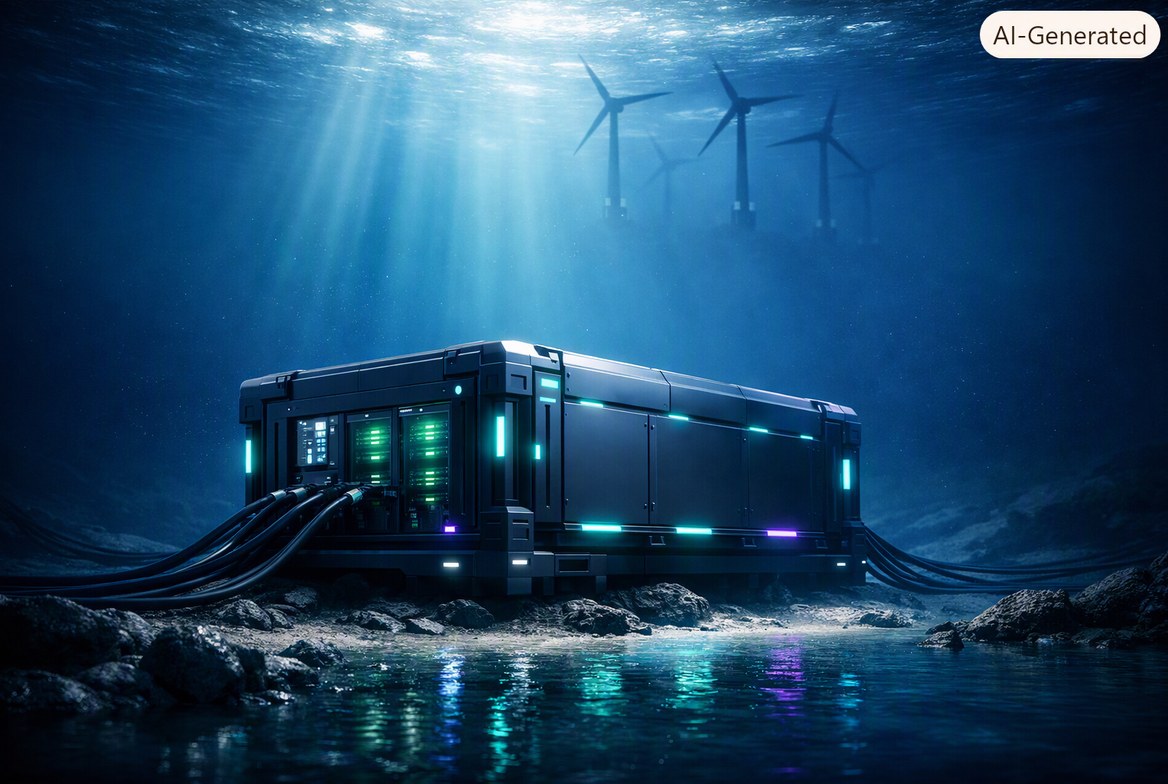
The growth of data centres, driven by artificial intelligence, is increasing the consumption of energy and of water for cooling. Among the solutions being tested are underwater data centres, which place servers on the seabed and use seawater to cool them. This overview gathers data on the sector’s consumption, on the facilities built and on the environmental questions still open.
The energy demand of data centres
According to the International Energy Agency (IEA), data centre electricity consumption is estimated at around 485 terawatt-hours (TWh) in 2025 and could almost double, reaching about 950 TWh in 2030, around 3% of global electricity demand. In 2025 data centre demand grew by 17%, and that of centres dedicated to artificial intelligence rose even faster. The IEA identifies artificial intelligence as the main driver of this growth. It is not only energy that weighs: cooling requires large amounts of water, and the Agency notes that liquid systems can cut direct water use by 70-90% compared with other solutions. Consumption of AI-focused centres, the IEA stresses, is set to triple by 2030, and the capital expenditure of five large technology companies, driven by data centres, exceeded US$ 400 billion in 2025. It is this pressure on energy, water and land that is driving the search for alternative cooling and siting solutions.
How underwater data centres work
The idea is to place servers in sealed modules on the seabed and use seawater as a cooling source, pumping it through radiators behind the racks. According to the research institute Merics, China has brought into operation the world’s first commercial underwater data centre in Hainan and a module powered by offshore wind in Shanghai. The Hainan facility, whose testing began in 2023, places 35 metres deep cabins with 24 racks each, for up to around 500 servers (the largest centres hold more than 10,000); the engineering is led by the company Highlander. The Shanghai module, according to press reports, is powered by a wind farm and hosts around 2,000 servers, with an investment of about US$ 226 million and a capacity of the order of 24 megawatts. The technology had been tested by Microsoft in 2018 (Project Natick) and then shelved; in the United States some start-ups such as Subsea Cloud and NetworkOcean remain active, the latter reportedly facing permitting obstacles for a trial in San Francisco Bay. Merics also recalls that the Hainan facility, launched as a pilot in 2023, initially provided data storage for the free-trade port and telecom operators before opening up to cloud and artificial intelligence firms.
The claimed advantages
According to Merics, the use of seawater makes the Hainan facility 40 to 60% more energy efficient than traditional centres, which cool by spraying chilled water. Supporters also point to lower use of land and fresh water and the possibility of pairing the facilities with offshore wind power, containing emissions. In a fast-growing sector, these efficiency margins are presented as a way to limit the growth of consumption linked to artificial intelligence. The IEA, for its part, observes that the gains achieved in cooling and in the siting of facilities weigh increasingly on the overall energy and water balance of data centres, and are therefore at the centre of the sector’s research.
The open environmental questions
The advantages come with unknowns. Merics notes that the environmental impacts of underwater data centres, particularly on marine ecosystems during heatwaves, remain understudied. Engineering challenges also remain open: sealing the modules, the corrosiveness of seawater, the high-pressure environment and the difficulty of maintenance, which may require lifting entire modules to the surface. Among the concerns flagged by observers are the release of heat into the water, which could alter local ecosystems, and the disposal of modules at the end of their life. There is, finally, the question of scale: the facilities built offer medium-sized capacity, far from that of the large land-based centres, which can hold more than 10,000 servers, and it is not yet demonstrated that the efficiency gains hold at larger volumes.
Outlook
According to Merics, if the first projects succeed, underwater data centres powered by renewable sources could spread rapidly, in a context where large investments are concentrated on infrastructure for artificial intelligence. What remains to be defined is independent monitoring of the effects on marine ecosystems, the technical and maintenance standards, and field verification of energy and water consumption compared with traditional facilities.
In dialogue with the 2030 Agenda
- Goal 9 (Industry, Innovation and Infrastructure). Data centres are critical infrastructure of the digital economy; underwater solutions seek a more efficient version.
- Goal 7 (Affordable and Clean Energy). Pairing with offshore wind and efficiency gains aim to contain the sector’s energy consumption.
- Goal 13 (Climate Action). Reducing the energy and emissions of data centres bears on meeting climate goals.
- Goal 14 (Life Below Water). The effects on marine ecosystems, still little studied, are the main open environmental issue.